
Tadalafil: A Deep Dive Into Benefits, Usage, and Expert Insights
Mark Evans Mark Evans
0 Course Enrolled • 0 Course CompletedBiography
Reliable QSDA2024 Braindumps Book & Question QSDA2024 Explanations
Our company is a multinational company with sales and after-sale service of QSDA2024 exam torrent compiling departments throughout the world. In addition, our company has become the top-notch one in the fields, therefore, if you are preparing for the exam in order to get the related QSDA2024 certification, then the QSDA2024 Exam Question compiled by our company is your solid choice. All employees worldwide in our company operate under a common mission: to be the best global supplier of electronic QSDA2024 exam torrent for our customers to pass the QSDA2024 exam.
Qlik QSDA2024 Exam Syllabus Topics:
| Topic | Details |
|---|---|
| Topic 1 |
|
| Topic 2 |
|
| Topic 3 |
|
| Topic 4 |
|
| Topic 5 |
|
>> Reliable QSDA2024 Braindumps Book <<
Easy To Use and Compatible Exam4Labs Qlik QSDA2024 Questions Formats
Our Desktop version is an application software that runs without an internet connection. It helps you to test yourself by giving the Qlik Sense Data Architect Certification Exam - 2024 (QSDA2024) practice test. Our desktop version also keeps a record of your previous performance and it shows the improvement in your next QSDA2024 Practice Exam. With the help of Exam4Labs Qlik Sense Data Architect Certification Exam - 2024 (QSDA2024) exam questions, you will be able to pass Qlik QSDA2024 certification exam with ease. When you invest in our product it will surely benefit your Qlik Sense Data Architect Certification Exam - 2024 (QSDA2024) exam dumps.
Qlik Sense Data Architect Certification Exam - 2024 Sample Questions (Q14-Q19):
NEW QUESTION # 14
Exhibit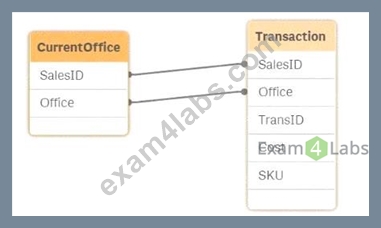
Refer to the exhibit.
The salesperson ID and the office to which the salesperson belongs is stored for each transaction. The data model also contains the current office for the salesperson. The current office of the salesperson and the office the salesperson was in when the transaction occurred must be visible. The current source table view of the model is shown. A data architect must resolve the synthetic key.
How should the data architect proceed?
- A. Force concatenation between the tables
- B. Comment out the Office in the Transaction table
- C. Inner Join the Transaction table to the CurrentOffice table
- D. Alias Office to CurrentOffice In the CurrentOffice table
Answer: D
Explanation:
In the provided data model, both the CurrentOffice and Transaction tables contain the fields SalesID and Office. This leads to the creation of a synthetic key in Qlik Sense because of the two common fields between the two tables. A synthetic key is created automatically by Qlik Sense when two or more tables have two or more fields in common. While synthetic keys can be useful in some scenarios, they often lead to unwanted and unexpected results, so it's generally advisable to resolve them.
In this case, the goal is to have both the current office of the salesperson and the office where the transaction occurred visible in the data model. Here's how each option compares:
* Option A: Comment out the Office in the Transaction table:This would remove the Office field from the Transaction table, which would prevent you from seeing which office the salesperson was in when the transaction occurred. This option does not meet the requirement.
* Option B: Inner Join the Transaction table to the CurrentOffice table:Performing an inner join would merge the two tables based on the common SalesID and Office fields. However, this might result in a loss of data if there are sales records in the Transaction table that don't have a corresponding record in the CurrentOffice table or vice versa. This approach might also lead to unexpected results in your analysis.
* Option C: Alias Office to CurrentOffice In the CurrentOffice table:By renaming the Office field in the CurrentOffice table to CurrentOffice, you prevent the synthetic key from being created. This allows you to differentiate between the salesperson's current office and the office where the transaction occurred. This approach maintains the integrity of your data and allows for clear analysis.
* Option D: Force concatenation between the tables:Forcing concatenation would combine the rows of both tables into a single table. This would not solve the issue of distinguishing between the current office and the office at the time of the transaction, and it could lead to incorrect data associations.
Given these considerations, the best approach to resolve the synthetic key while fulfilling the requirement of having both the current office and the office at the time of the transaction visible is toAlias Office to CurrentOffice in the CurrentOffice table. This ensures that the data model will accurately represent both pieces of information without causing synthetic key issues.
NEW QUESTION # 15
Exhibit.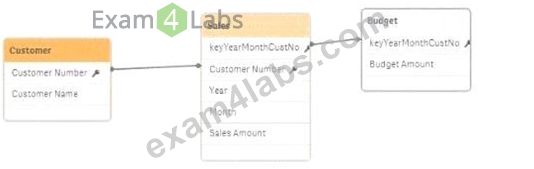
Refer to the exhibit.
The data architect needs to build a model that contains Sales and Budget data for each customer. Some customers have Sales without a Budget, and other customers have a Budget with no Sales.
During loading, the data architect resolves a synthetic key by creating the composite key.
For validation, the data architect creates a table that contains Customer, Month, Sales, and Budget columns.
What will the data architect see when selecting a month?
- A. All Customer Names for both Sales and Budget records for the selected month
- B. Customer Names and Budaets records for the selected month. Sales column can contain null or non-null values
- C. Customer Names and Sales records for the selected month, Budgets column can contain null or non-null values
- D. Customer Names and Sales records for the selected month but with only non-null values in Budget column
Answer: C
Explanation:
In the scenario where the data model is built with a composite key (keyYearMonthCustNo) to resolve synthetic keys, the following outcomes occur:
* Sales and Budget Data Integration:
* The composite key ensures that each combination of Year, Month, and Customer is uniquely represented in the combined Sales and Budget data.
* During data selection (e.g., when a specific month is selected), Qlik Sense will show all the customer names that have either Sales or Budget data associated with that month.
* Resulting Data View:
* For the selected month, customers with sales records will display their Sales data. However, if the corresponding Budget data is missing, the Budget column will contain null values.
* Similarly, if a customer has a Budget but no Sales data for the selected month, the Sales column will show null values.
Validation Outcome:When the data architect selects a month, they will see the following:
* Customer Names and Sales recordsfor the selected month, where the Sales column will have values and the Budget column may contain null or non-null values depending on the data availability.
NEW QUESTION # 16
A company generates l GB of ticketing data daily. The data is stored in multiple tables. Business users need to see trends of tickets processed for the past 2 years. Users very rarely access the transaction-level data for a specific date. Only the past 2 years of data must be loaded, which is 720 GB of data.
Which method should a data architect use to meet these requirements?
- A. Load only aggregated data for 2 years and use On-Demand App Generation (ODAG) for transaction data
- B. Load only 2 years of data in an aggregated app and create a separate transaction app for occasional use
- C. Load only 2 years of data and use best practices in scripting and visualization to calculate and display aggregated data
- D. Load only aggregated data for 2 years and apply filters on a sheet for transaction data
Answer: A
Explanation:
In this scenario, the company generates 1 GB of ticketing data daily, accumulating up to 720 GB over two years. Business users mainly require trend analysis for the past two years and rarely need to access the transaction-level data. The objective is to load only the necessary data while ensuring the system remains performant.
Option Cis the optimal choice for the following reasons:
* Efficiency in Data Handling:
* By loading only aggregated data for the two years, the app remains lean, ensuring faster load times and better performance when users interact with the dashboard. Aggregated data is sufficient for analyzing trends, which is the primary use case mentioned.
* On-Demand App Generation (ODAG):
* ODAG is a feature in Qlik Sense designed for scenarios like this one. It allows users to generate a smaller, transaction-level dataset on demand. Since users rarely need to drill down into transaction-level data, ODAG is a perfect fit. It lets users load detailed data for specific dates only when needed, thus saving resources and keeping the main application lightweight.
* Performance Optimization:
* Loading only aggregated data ensures that the application is optimized for performance. Users can analyze trends without the overhead of transaction-level details, and when they need more detailed data, ODAG allows for targeted loading of that data.
References:
* Qlik Sense Best Practices: Using ODAG is recommended when dealing with large datasets where full transaction data isn't frequently needed but should still be accessible.
* Qlik Documentation on ODAG: ODAG helps in maintaining a balance between performance and data availability by providing a method to load only the necessary details on demand.
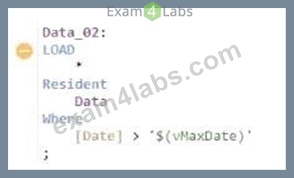
NEW QUESTION # 17
exhibit.
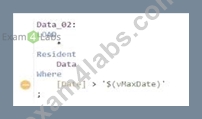
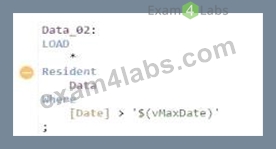
A data architect is validating that the script section, as shown in the exhibit, is working properly. They need to stop the script with a preview of the value used with the Load statement.
Where should the data architect put the debugger breakpoint?
- A.
- B.
- C.
- D.

Answer: A
Explanation:
In this scenario, the data architect needs to validate the script and specifically ensure that the vMaxDate variable is being correctly utilized in the LOAD statement. The goal is to stop the script execution at a point where the variable's value can be previewed.
Understanding the Options:
* Option Aplaces the breakpoint just after the assignment of the variable vMaxDate in the Where clause but before any data is loaded.
* Option B, C, and Drepresent placements of the breakpoint after the LOAD statement begins processing the Resident table, which means that the variable vMaxDate would have already been utilized.
Correct Breakpoint Placement:
* Option Ais the correct choice because placing the breakpoint at this point allows you to preview the value of vMaxDate right before it is used in the Where clause. This placement ensures that the script execution halts before loading the data, allowing you to validate whether vMaxDate is correctly defined and whether it correctly filters the data based on the [Date] field.
* If the breakpoint were placed after the LOAD statement (as in Options B, C, or D), the script would have already attempted to load the data, making it too late to inspect the variable's value before it's used.
References:
* Qlik Sense Debugging Best Practices: When debugging, it is crucial to set breakpoints before the execution of a critical operation where the values of variables or fields are used to ensure that they hold the expected data.
NEW QUESTION # 18
A data architect inherits an app that takes too long to load and overruns the data load window.
The app pulls all records (new and historical) from three large databases. The reload process puts a heavy load on the source database servers. All of the data is required for analysis.
What should the data architect do?
- A. Implement Direct Discovery with partial load
- B. Implement incremental load on each database using QVD files
- C. Implement ODAG to split out the app into smaller chunks
- D. Make sure the individual reload tasks in the QMC are not running in parallel
Answer: B
Explanation:
The scenario describes an app that is experiencing long load times due to the need to pull all records, both new and historical, from three large databases. This situation puts a strain on both the Qlik environment and the source databases. Given that all data is required for analysis, a full reload each time can be inefficient and resource-intensive.
Implementingincremental loadis a widely recommended approach in such cases. Incremental loading allows you to load only new or changed data since the last reload, rather than reloading all the data every time. This significantly reduces the time and resources required for reloading, as only a subset of the data needs to be processed during each reload. QVD (QlikView Data) files are typically used to store the historical data, while only the new or updated records are fetched from the source databases.
This approach would help:
* Reduce the load on the source databases.
* Shorten the data reload window.
* Maintain historical data efficiently while ensuring that all new data is captured.
NEW QUESTION # 19
......
Exam4Labs Qlik QSDA2024 practice exam is the most thorough, most accurate and latest practice test. You will find that it is the only materials which can make you have confidence to overcome difficulties in the first. Qlik QSDA2024 exam certification are recognized in any country in the world and all countries will be treate it equally. Qlik QSDA2024 Certification not only helps to improve your knowledge and skills, but also helps your career have more possibility.
Question QSDA2024 Explanations: https://www.exam4labs.com/QSDA2024-practice-torrent.html
- Download QSDA2024 Demo 🛺 Latest QSDA2024 Test Testking 🛄 QSDA2024 Vce Files 🌋 Search for ➽ QSDA2024 🢪 and download exam materials for free through ➠ www.pdfdumps.com 🠰 ✒Test QSDA2024 Dates
- Free Qlik QSDA2024 Questions [2025] – Fully Updated ⛲ Easily obtain 「 QSDA2024 」 for free download through ▛ www.pdfvce.com ▟ 👒Test QSDA2024 Simulator Online
- QSDA2024 Examcollection ♻ Reliable QSDA2024 Braindumps Files ⌛ Valid QSDA2024 Test Pattern 😮 { www.dumps4pdf.com } is best website to obtain 【 QSDA2024 】 for free download 🌆QSDA2024 Latest Dumps Free
- QSDA2024 Valid Braindumps 🌄 QSDA2024 Latest Real Test 🤥 Reliable QSDA2024 Braindumps Files 📮 Easily obtain free download of ➤ QSDA2024 ⮘ by searching on ▛ www.pdfvce.com ▟ 🔦QSDA2024 Valid Test Labs
- 2025 Authoritative QSDA2024: Reliable Qlik Sense Data Architect Certification Exam - 2024 Braindumps Book 🚻 Simply search for ▷ QSDA2024 ◁ for free download on ▷ www.examcollectionpass.com ◁ 🦠Latest QSDA2024 Test Testking
- Reliable QSDA2024 Braindumps Files 🧫 Reliable QSDA2024 Braindumps Files 🦘 Test QSDA2024 Simulator Online ↩ Search for 【 QSDA2024 】 and download it for free immediately on ▷ www.pdfvce.com ◁ 💘QSDA2024 Valid Test Labs
- Test QSDA2024 Dates 🎲 QSDA2024 Examcollection ⏭ Test QSDA2024 Dates 🥁 Download 「 QSDA2024 」 for free by simply entering [ www.passcollection.com ] website 🚀QSDA2024 PDF Guide
- QSDA2024 Valid Dumps Ebook 🍳 QSDA2024 Latest Real Test 🔕 QSDA2024 Latest Dumps Free 📻 Go to website ➤ www.pdfvce.com ⮘ open and search for 「 QSDA2024 」 to download for free ℹQSDA2024 Valid Dumps Ebook
- Try Qlik QSDA2024 Exam Questions For Sure Success 📒 ⇛ www.exams4collection.com ⇚ is best website to obtain ➽ QSDA2024 🢪 for free download 🦐Test QSDA2024 Dates
- 100% Pass 2025 Qlik QSDA2024: Qlik Sense Data Architect Certification Exam - 2024 First-grade Reliable Braindumps Book 📄 Easily obtain ▶ QSDA2024 ◀ for free download through ➡ www.pdfvce.com ️⬅️ 🐍QSDA2024 Valid Dumps Ebook
- Braindumps QSDA2024 Downloads 💇 Download QSDA2024 Demo ⛪ QSDA2024 Vce Files 🐶 Immediately open ⇛ www.dumpsquestion.com ⇚ and search for ✔ QSDA2024 ️✔️ to obtain a free download 🐩QSDA2024 Latest Real Test
- QSDA2024 Exam Questions
- krisztinakonya.com www.academy.pnuxelconsulting.com e-learning.gastroinnovation.eu upskilllab.simpleforedesign.com pacificoutsourcinginstitute.com tattoo-courses.com graphiskill.com www.meilichina.com educatorsempowerment.com primewayedu.com